Documented Processes vs. “It’s in My Head” — The Hidden Growth Killer
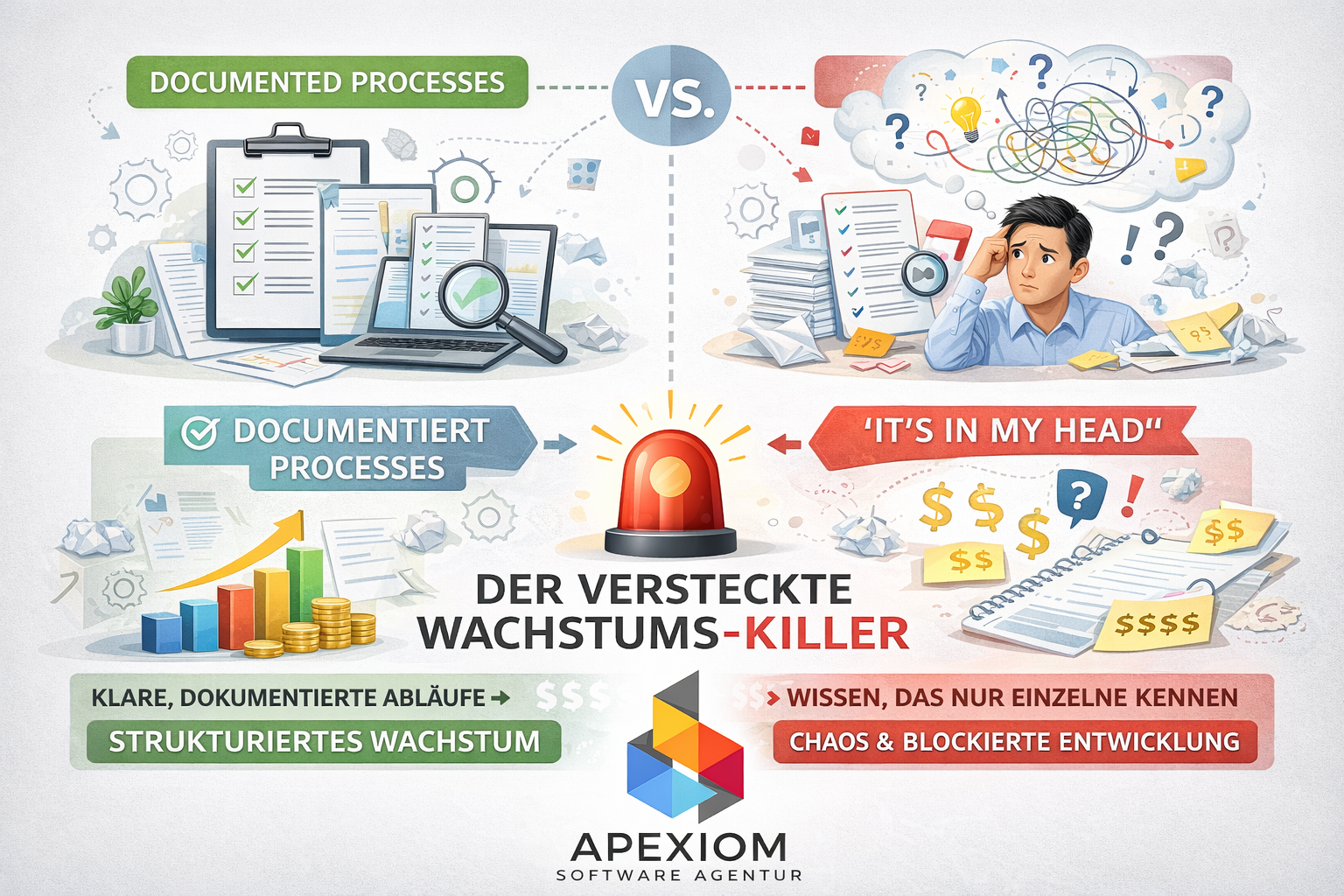
In many growing businesses, important knowledge lives in the minds of a few key people. Tasks are handled based on experience, verbal instructions, and personal habits rather than clear, documented workflows. At first, this may feel efficient. Teams move quickly, people solve problems on the spot, and daily operations seem to work. But as the company grows, this model becomes a serious weakness. Once more employees, more clients, and more complexity enter the picture, undocumented processes create confusion, slow down execution, and make the business highly dependent on individuals. This is where growth starts to stall. Not because the company lacks demand or talent, but because the knowledge required to operate efficiently is not built into the business itself. It is trapped in people instead of being turned into systems.
Why undocumented processes become a major business risk
Undocumented processes are often tolerated for too long because they do not immediately look like a problem. Work still gets done. Customers are still served. Internal tasks are still completed. But behind the surface, the company becomes fragile. When processes are not written down, every recurring task depends on memory, interpretation, and availability. One employee may handle a process one way, another may do it differently, and no one has a clear reference point for what the correct version actually is. This leads to inconsistency, delays, and unnecessary mistakes. The real danger appears when a key person is unavailable. If someone goes on vacation, becomes sick, or leaves the company, important knowledge can disappear overnight. At that point, the business realizes it was never running on a reliable system. It was running on individual memory.
The hidden cost of “it’s in my head” operations
When business knowledge is not documented, the cost is rarely obvious at first. It does not always appear as a single large problem. Instead, it shows up in small inefficiencies that accumulate over time. Teams ask the same questions repeatedly. Managers spend too much time clarifying tasks. New employees need longer to become productive. Work quality depends on who is handling the task. Errors happen because steps are skipped or interpreted differently. These issues may seem minor in isolation, but together they reduce speed, consistency, and profitability. There is also a strategic cost. A company cannot scale effectively if growth depends on a handful of people carrying operational knowledge in their heads. This limits delegation, slows down onboarding, and makes expansion far more difficult than it needs to be. In other words, undocumented processes do not just create internal friction. They actively reduce the company’s ability to grow.
Clear signs your business depends too much on individual knowledge
Many companies do not notice the problem until it becomes painful. However, there are several clear warning signs that indicate a business is relying too heavily on undocumented knowledge. Typical signs include: new employees take too long to learn routine tasks work is completed differently depending on who handles it important tasks slow down when one specific person is absent team members constantly ask others how something is done recurring mistakes happen even though the task is familiar managers are repeatedly pulled into operational details there is no single source of truth for how tasks should be performed If several of these signs are present, the issue is not just a communication problem. It is a systems problem.
Why SOPs are essential for sustainable scaling
Standard Operating Procedures, or SOPs, are one of the most effective ways to turn knowledge into a scalable business asset. They create consistency by clearly documenting how recurring processes should be performed, who is responsible, which tools are used, and what the expected outcome should be. This does not mean businesses need complex manuals for everything. A good SOP is practical, clear, and focused on execution. Its purpose is to make work repeatable and understandable, even when the usual person is not available. When workflows are documented properly, companies become easier to manage, easier to scale, and less vulnerable to disruption. Employees can be onboarded faster, teams can collaborate more efficiently, and operations become more stable as the business grows. SOPs help move the business from person-dependent execution to system-based execution. That shift is what makes sustainable growth possible.
Which workflows should be documented first
Not every process needs to be documented at once. The smartest approach is to begin with the workflows that have the biggest impact on daily operations, customer experience, and revenue. The best starting points are usually:
- client onboarding
- proposal and quotation creation
- invoicing and payment follow-up
- internal approval processes
- customer support handling
- marketing campaign workflows
- project handovers
- reporting procedures
- software deployment or technical maintenance routines
These are usually the areas where inconsistency creates the most damage. By documenting them first, companies quickly reduce chaos and improve reliability.
How to build practical documented processes that people actually use
A documented process only creates value if people can actually use it. That means it should be easy to understand, easy to access, and written in a way that supports action rather than theory. A practical workflow document should answer a few simple questions: What is the goal of this process? Who is responsible for it? Which tools or systems are needed? What are the exact steps? What common errors should be avoided? What does a successful result look like? The best process documentation is clear, concise, and regularly updated. It should reflect how the work is truly done, not how someone imagines it should be done. If documentation is too vague, too long, or too disconnected from reality, teams will ignore it. That is why process documentation should be treated as a living operational tool, not as a one-time internal document.
Documented workflows improve efficiency, onboarding, and resilience
Documented workflows create benefits far beyond process clarity. They improve execution quality because tasks are performed more consistently. They improve onboarding because new employees have a clear structure to follow. They also improve resilience because the business is no longer dependent on a small number of individuals. This becomes especially important during periods of growth. As teams expand, communication becomes more complex and operational gaps become more expensive. Without clear documentation, companies often respond by adding more meetings, more supervision, and more manual coordination. That may temporarily reduce friction, but it does not solve the underlying issue. Documented processes do. They reduce dependency, support delegation, and create the operational foundation a business needs to grow without losing control.
Conclusion: growth needs systems, not memory
Many businesses believe their biggest growth challenge is generating more leads, closing more sales, or hiring more people. In reality, growth often breaks down much earlier — at the operational level. If essential knowledge remains undocumented, the business becomes harder to manage with every new client, every new employee, and every new process. What once felt fast and flexible turns into inconsistency, bottlenecks, and hidden risk. Companies that want to scale successfully need more than capable people. They need systems that make knowledge transferable, execution repeatable, and quality consistent. That is exactly what documented processes and SOPs provide.
FAQ
What are documented processes in a business?
Documented processes are written step-by-step descriptions of how recurring tasks and workflows should be completed inside a business. They help ensure consistency, reduce confusion, and make operations easier to scale.
Why are SOPs important for business growth?
SOPs are important because they turn operational knowledge into repeatable systems. This reduces dependency on individual employees, improves onboarding, and allows the business to grow more efficiently.
What happens if business processes are not documented?
If processes are not documented, teams rely too much on memory and verbal knowledge. This leads to delays, mistakes, inconsistency, and operational risk when key people are unavailable.
Which processes should a company document first?
A company should start by documenting recurring, high-impact workflows such as onboarding, invoicing, approvals, support, and delivery-related processes.
Are documented workflows only useful for large companies?
No. Small and medium-sized businesses often benefit the most because clear workflows make it easier to grow without creating internal chaos or relying on a few experienced employees.
Want to build a business that scales beyond individual knowledge?
APEXIOM-SE helps companies document processes, structure workflows, and build operational systems that support long-term growth, efficiency, and resilience. If your business is still relying too heavily on “it’s in my head,” now is the time to turn knowledge into a scalable system.
More posts




Let’s build your digital future together
From the first idea to measurable success, Apexiom Engineering is your partner for software, AI and sustainable growth. Made in Germany, personal and on equal footing.