How to Measure ROI From AI: The KPIs Every Business Should Track
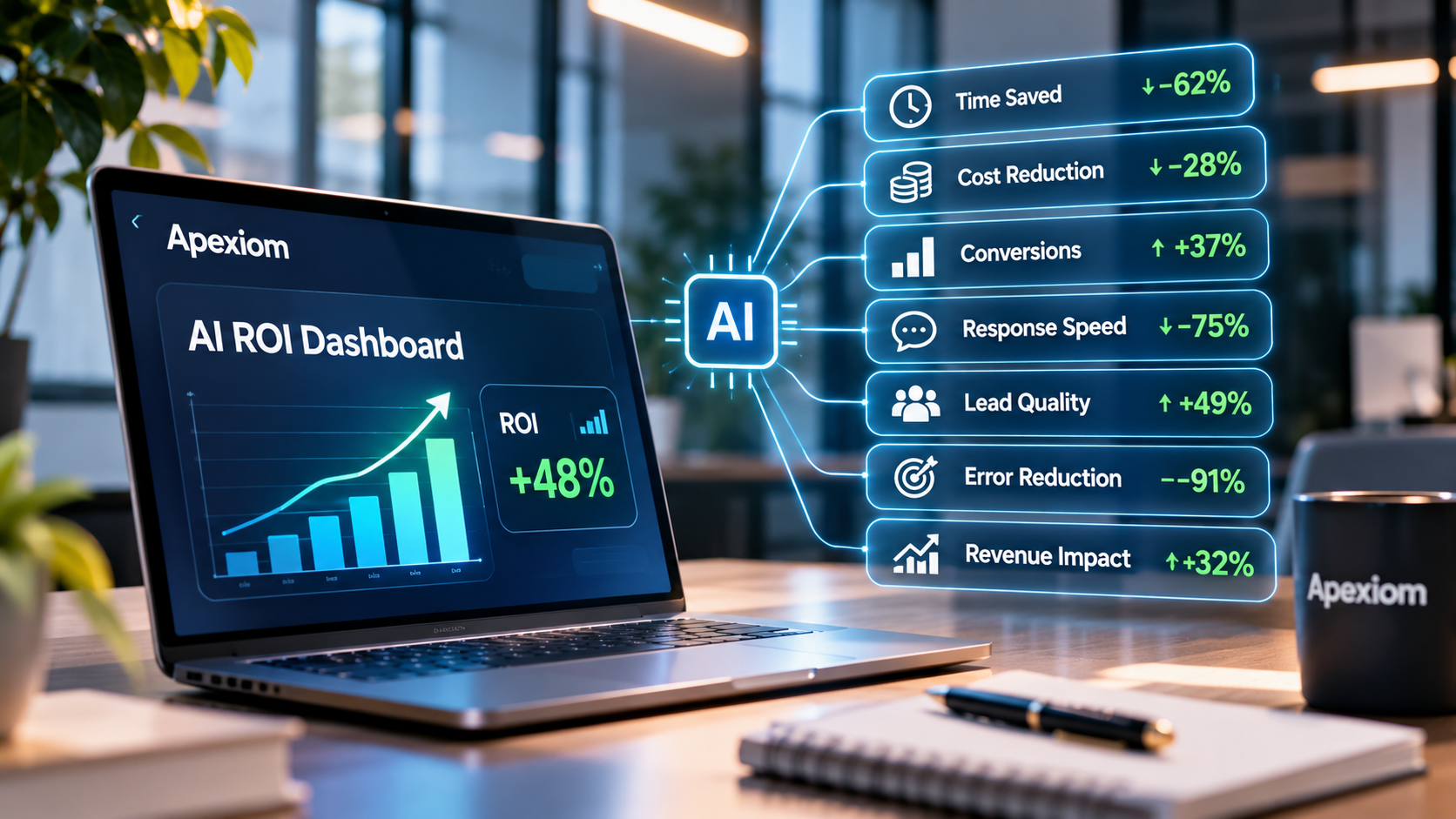
Many organizations increasingly adopt AI technologies but often struggle to determine whether these investments are paying off. Establishing clear baselines and measurable objectives is crucial for effectively evaluating the success of these technologies. In this article, we’ll discuss ROI definitions, key performance indicators (KPIs), and practical steps to assess AI effectiveness for SMEs.
Understanding AI ROI
Return on Investment (ROI) is a metric used to assess the efficiency of an investment, usually expressed as a percentage. Businesses should consider various dimensions when evaluating AI applications, including efficiency gains, cash savings, revenue, and profit. It’s important to clearly differentiate these terms to gain an accurate understanding of AI's impact.
The ROI Formula
The basic formula to calculate ROI is: ROI (%) = (Net Benefits / Total Costs) × 100. Total costs should encompass not just software fees, but also implementation costs, integrations, training, review, and maintenance expenses. Thorough cost consideration is essential for creating an accurate ROI picture.
Seven KPIs You Should Track
To measure the performance of your AI initiatives, you should consider tracking the following KPIs regularly.
- Time Saved: This is defined as the time saved through AI implementation, which can be measured using time tracking and planning reports.
- Cost Reduction: Measure the decrease in operational costs due to AI by analyzing expense reports and budget plans.
- Conversion Rate: Calculate the number of sales or leads generated by AI in relation to your marketing costs.
- Response Speed: Measure how quickly your company responds to customer inquiries before and after AI implementation.
- Lead Quality: Assess the quality of leads generated by automated systems, based on sales figures and feedback.
- Error Reduction: Determine the number of errors avoided due to AI compared to a prior benchmark.
- Revenue Impact: Measure the difference in revenue attributed to AI implementation and relate this to overall sales figures.
Measurement Methods
The reliability of your ROI measurement derives from established baselines and comparisons between pre- and post-AI implementation. Methods include:
- Before-and-After Baselines: These help to directly identify improvements after implementation.
- Control Groups, where applicable: Utilizing a control group enables you to measure impacts only after AI is actively in use.
- CRM Records: Leverage your existing Customer Relationship Management data for insights.
- Time Tracking: Utilize time tracking tools to measure productivity gains.
- Financial Reports: Consolidate your findings from financial reports.
- Customer Service Analytics: Use analytics tools to evaluate the quality of customer interactions.
Hypothetical Case Study
Let’s consider a hypothetical service company with 25 employees implementing AI in sales, administration, and support. The following tables present baseline and pilot results as a comparison:
Financial Summary: Monthly Benefit and Other Metrics
To measure the financial viability of your AI investments, you need to calculate various values such as the monthly net benefit, which is based on assumptions you’ve clearly defined. This way, you can also determine the rental rate of return (ROI) and the payback period for your investment.
Attribution and Risks
A thorough evaluation also considers seasonality, process changes, data quality, employee adoption issues, and hidden costs. Oftentimes, organizations measure vanity metrics that do not ultimately reflect true success.
Practical 30-Day Plan
To put the elements mentioned above into action, a pragmatic 30-day plan could look as follows:
- Select the key KPIs you wish to track.
- Establish clear baselines to anticipate results.
- Conduct a pilot for a selected workflow.
- Review the results critically and analyze everything.
- Decide whether to scale the AI application based on your findings.
Conclusion
With clear metrics and target settings, you can make your AI expenditures accountable. The next step is to initiate a conversation with Apexiom about AI implementation and measurement to maximize your investment’s benefits.
More posts
 AI & Automation
What Comes After Automation? Building an AI-First Operating Model
November 6, 2026 AI & Automation
The AI Tool Stack Problem: Why More AI Tools Do Not Always Mean More Productivity
November 2, 2026 AI & Automation
Build vs. Buy: Should Your Business Use Off-the-Shelf AI or a Custom AI Solution?
October 30, 2026
Let’s build your digital future together
From the first idea to measurable success, Apexiom Engineering is your partner for software, AI and sustainable growth. Made in Germany, personal and on equal footing.