AI Can Write Code. But Who Takes Responsibility for the Result?
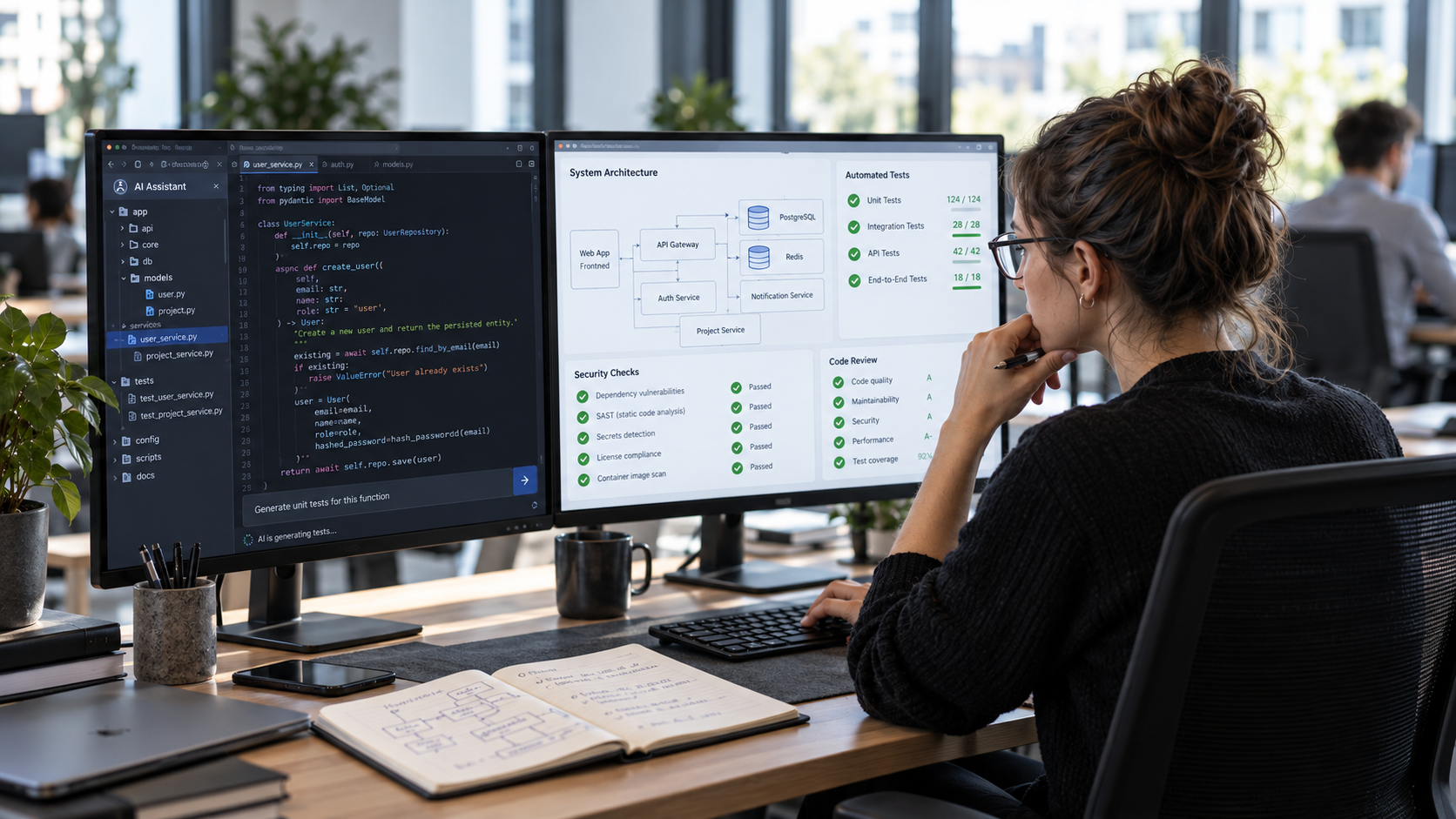
Why successful software requires more than good prompts, and why human expertise remains essential in the age of AI.
Artificial intelligence is fundamentally changing software development. Today, websites can be created, user interfaces designed, and functional applications built in a matter of minutes. Tasks that once took hours or days can now be completed significantly faster with the right tools.
For businesses, this creates new opportunities. Ideas can be tested more quickly, development processes accelerated, and certain costs reduced.
But this is where an important misunderstanding begins.
When AI creates an application in minutes, it does not automatically mean that the application is ready for real-world business use.
Generating code has become easier. Engineering reliable software remains a technical and business challenge.
1. What an Impressive Demo Doesn't Show
Social media is increasingly filled with videos showing people creating entire websites or applications with just a few prompts. The results look convincing and often work surprisingly well.
But a demonstration only shows a small part of reality.
What happens when a client changes their requirements? When multiple users access the same data simultaneously? When a payment fails, an API becomes unavailable, or confidential information is not properly protected?
These are precisely the situations that determine whether software works reliably in everyday business operations.
A prototype needs to demonstrate that an idea is feasible. A production-ready system must go further. It must be reliable, secure, maintainable, and aligned with the actual business processes it is designed to support.
There is a significant amount of engineering work between these two objectives.
2. When the Application Works, but the System Behind It Doesn't
Imagine a company that uses AI to quickly create an internal management application.
The interface looks modern. Employees can enter data, retrieve information, and manage tasks. During the initial demonstration, everything works as expected.
A few weeks later, problems begin to appear.
Employees may be able to access information they should not see. Some records are saved twice. A previously working feature breaks after a minor change. The application becomes difficult to extend because its underlying architecture was never properly designed.
The problem is not that AI was used. The problem is that the solution may not have been adequately reviewed, tested, or prepared for real-world use.
An experienced software engineer looks beyond visible features. They examine the system architecture, access permissions, data structures, error handling, integrations, and long-term maintainability.
Because software must not only work today. It must continue to work reliably tomorrow.
3. AI Can Generate Code. Technical Decisions Still Matter.
Modern AI tools can support developers in many ways. They generate code, suggest solutions, explain errors, and automate repetitive tasks.
This makes them valuable tools in modern software development.
However, generated code must be evaluated within the context of the entire system.
Is the chosen architecture appropriate for the project? Have security risks been considered? Are error scenarios handled correctly? Can new features be integrated later? Does the implementation actually meet the business requirements?
AI can help answer these questions, but its suggestions still need to be verified and evaluated against the project's actual needs.
Even an AI tool that successfully fixes one bug can introduce another problem elsewhere. Without appropriate testing and technical understanding, these issues may go unnoticed.
The real difference is not whether AI is used, but how thoughtfully, carefully, and professionally it is applied.
4. Vibe Coding: Powerful, but Not Sufficient for Every Project
Vibe coding is an approach to software development in which applications are created primarily through natural-language instructions and AI-generated code, often without the user implementing or understanding every technical detail.
This approach has real value.
It is particularly useful for prototypes, experiments, simple applications, and quickly validating new ideas. Experienced developers also use these tools to improve their productivity.
Problems arise when a quickly generated prototype is treated as a finished business solution without adequate technical review.
People who do not understand the underlying software may struggle to investigate bugs systematically, identify security vulnerabilities, or resolve unexpected issues.
This does not mean every developer must write every line of code manually. It means someone must take responsibility for ensuring that the complete system is understandable, tested, and reliable.
AI is a tool. The quality of the result also depends on how that tool is used and supervised.
5. Why Professional Software Engineers Still Matter
A software engineer's job involves much more than writing code.
Professional engineers translate business requirements into technical solutions. They determine how systems should be structured, how data should be processed, and how different components should communicate.
They consider security, performance, maintainability, and future expansion. They investigate failures, validate technical assumptions, and ensure that the solution works in real operating conditions.
AI can support and accelerate many of these activities. However, it does not automatically eliminate the need for people who can evaluate the results professionally.
An experienced engineer does not simply use AI to generate as much code as possible. They use it to make better decisions faster and dedicate more time to the technical challenges that matter most.
That is the difference between generating code and professional software engineering.
6. This Principle Extends Far Beyond IT
The same misunderstanding exists in many other industries.
A financial report generated by AI is not automatically a reliable financial analysis. A contract generated in seconds is not necessarily legally appropriate. An AI-generated marketing campaign does not guarantee that the underlying strategy is right for its target audience.
In every industry, intelligent tools can accelerate work. Expertise remains necessary to evaluate results, identify risks, and make informed decisions.
Technology can simplify the execution of a task. It cannot guarantee that the task was correctly defined, properly executed, or meaningfully integrated into a larger business context.
7. What Businesses Should Evaluate Before Choosing a Software Solution
The most important question is no longer simply: Can AI build this application?
Businesses should instead consider the following:
- Business value: Does the application solve the actual problem it was designed to address?
- Security: Are data, access permissions, and sensitive information adequately protected?
- Reliability: Has the application been tested under realistic conditions, including unexpected errors?
- Maintainability: Can the system be maintained, extended, and adapted to changing requirements over time?
- Integration: Does the solution work reliably with existing applications and business processes?
- Accountability: Who verifies the quality, investigates problems, and takes responsibility when something does not work as expected?
These questions matter regardless of whether an application is developed entirely by humans, with AI, or through a combination of both.
The right solution is not necessarily the one that can be built the fastest. What matters is whether it meets the requirements and continues to deliver value to the business over time.
8. How Apexiom Approaches AI in Software Development
At Apexiom, we see artificial intelligence as an opportunity to make software development more efficient and deliver better digital solutions to our clients.
AI can accelerate development processes, reduce repetitive work, and help explore new approaches. However, we believe these capabilities should be combined with sound technical expertise and structured development practices.
From the initial idea and technical planning to implementation, the business requirements must remain at the center of the process.
This includes an appropriate architecture, thorough testing, carefully considered security measures, and a solution that can be maintained and developed further over time.
A good digital solution is not defined solely by whether it can be created. It must also perform reliably in the everyday reality of a business.
Our goal is to use modern technologies intelligently and develop solutions that address real challenges, improve workflows, and evolve alongside our clients' needs.
Conclusion: Don't Just Build Faster. Build the Right Solution.
Artificial intelligence will continue to transform software development. It will create new opportunities, improve existing workflows, and significantly accelerate certain tasks.
The important question is therefore not whether businesses should use AI. It is how they can use this technology effectively without compromising quality, security, and reliability.
AI can accelerate development. Professional software engineering turns an idea into a well-designed, reliable, and maintainable solution.
If you are planning a digital project, do not ask only how quickly it can be built. Ask how well it will meet your business requirements, which risks have been considered, and how it will evolve over time.
Because in the end, it is not just about whether the software works.
It is about whether your business can depend on it.
Looking to develop a digital solution or modernize an existing application? Explore Apexiom's software development and digital solutions at apexiom.de.
More posts

.png)


Let’s build your digital future together
From the first idea to measurable success, Apexiom Engineering is your partner for software, AI and sustainable growth. Made in Germany, personal and on equal footing.