Why Most Business Websites Fail to Convert – And How to Turn Yours Into a Revenue Engine
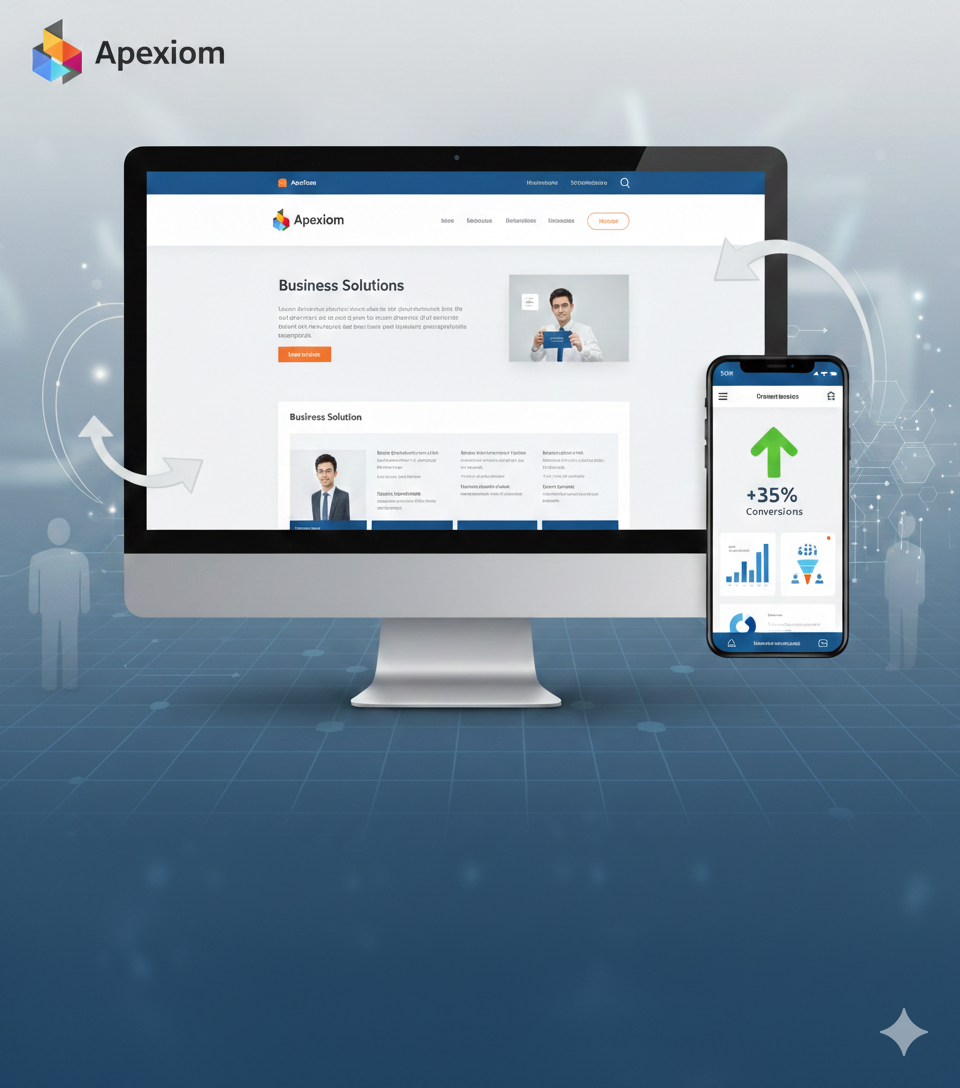
The Expensive Illusion of a “Modern” Website
In today’s digital economy, nearly every company understands the importance of having a website.
It is often the first touchpoint between brand and customer.
It represents credibility.
It communicates positioning.
But here is the uncomfortable truth:
Most business websites do not generate consistent conversions.
They may look modern.
They may be technically well-built.
They may even rank on Google.
Yet they fail at the one thing that truly matters:
turning visitors into customers.
The issue is rarely design alone.
It is rarely performance alone.
It is almost always a missing conversion strategy.
Websites Built for Aesthetics, Not Outcomes
Many development projects begin with the wrong priority:
- “We need something that looks premium.”
- “We want a clean, modern design.”
- “Let’s add animations.”
- “Make it similar to our competitor.”
While design quality is important, it is not the main driver of revenue.
A high-performing website must answer three strategic questions:
- Who is the exact target audience?
- What problem are they trying to solve?
- What action should they take next?
Without clear answers, even the most beautiful website becomes a static digital brochure.
No Defined Conversion Architecture
A website should never be a collection of pages. It should be a structured conversion system.
Yet many developers focus primarily on:
- Component implementation
- Layout responsiveness
- Backend structure
- Visual details
All necessary — but incomplete.
What is often missing is conversion architecture:
- Clear funnel stages
- Intent-based page structure
- Strategic CTA placement
- Trust-building elements
- Friction reduction mechanisms
When these elements are not planned from the beginning, the website lacks direction. Users scroll — but they do not act.
At Apexiom, every project begins with mapping the customer journey before any design is created.
Weak or Misplaced Calls-to-Action
Call-to-actions are not buttons. They are behavioral triggers.
However, many websites use vague and passive CTAs such as:
- “Learn More”
- “Explore”
- “Click Here”
These phrases do not communicate value.
Effective CTAs:
- Address a specific benefit
- Reduce psychological resistance
- Create clarity about the next step
For example:
- “Get Your Free Strategy Call”
- “Start Your Growth Analysis”
- “Request Your Custom Proposal”
Additionally, placement is critical.
A conversion-focused website:
- Places the primary CTA above the fold
- Repeats it strategically throughout the page
- Differentiates between primary and secondary actions
- Designs CTAs with visual hierarchy
When CTAs are unclear or poorly positioned, users hesitate — and hesitation kills conversion.
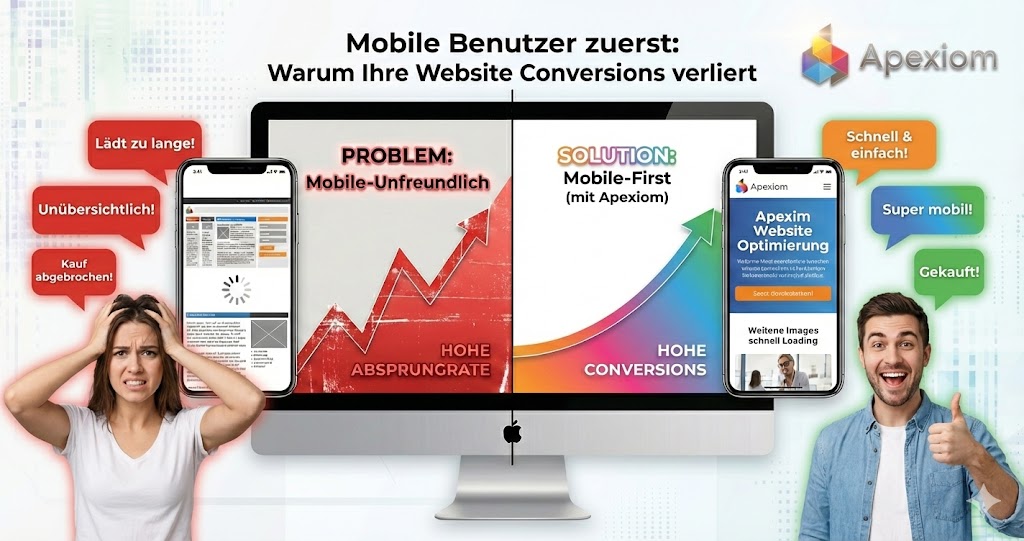
Mobile Is Responsive, But Not Optimized
Over 60% of website traffic now comes from mobile devices.
Yet many websites are only technically responsive — meaning they adapt to screen size — but are not behaviorally optimized for mobile users.
Mobile users:
- Have shorter attention spans
- Scroll faster
- Expect instant clarity
- Use thumbs, not cursors
If the mobile layout requires excessive scrolling, hides important CTAs, or loads slowly, conversion rates drop dramatically.
At Apexiom, we redesign mobile experiences intentionally:
- Shortened content blocks
- Sticky CTA buttons
- Optimized scroll flow
- Reduced cognitive overload
- Performance-first architecture
Because in reality:
If your mobile doesn’t convert, your website doesn’t convert.
No Data-Driven Optimization Strategy
Launching a website is not the final step. It is the beginning.
Many companies treat website development as a one-time project. Once live, nothing changes for years.
But high-converting websites are continuously optimized.
Professional conversion systems rely on:
- Conversion tracking setup
- Heatmaps
- User session recordings
- A/B testing
- Funnel drop-off analysis
- Performance metrics evaluation
Without data, decisions are based on opinion.
With data, decisions are based on behavior.
At Apexiom, we view websites as living growth systems that evolve through continuous testing and improvement.
Why Visitors Leave Without Acting
Conversion is not just technical. It is psychological.
Visitors ask themselves subconsciously:
- Is this trustworthy?
- Does this solve my specific problem?
- Is this worth my time?
- What happens if I click?
If your website does not clearly communicate:
- Authority
- Social proof
- Clear value proposition
- Risk reduction
users hesitate.
Trust elements such as:
- Testimonials
- Case studies
- Certifications
- Transparent process explanations
are not decorative — they are conversion drivers.
How Apexiom Transforms Websites into Revenue Systems
At Apexiom, we approach websites differently.
We do not ask:
“How should it convert?”
Our structured process includes:
- Conversion strategy development
- Target audience deep-dive
- Funnel mapping and user journey architecture
- Conversion-focused UX design
- Technical performance optimization
- Mobile-first refinement
- Ongoing data-based improvement
The goal is simple:
To transform your website from a digital business card into a measurable revenue engine.
The Strategic Mindset Shift
A website is not an expense. It is an investment. But like any investment, it must generate returns. If your website is not generating leads, inquiries, or measurable growth, the issue is not traffic alone. It is structure. It is strategy. It is conversion thinking.
Conclusion
A visually attractive website without conversion architecture is like a store with no checkout counter.
Visitors may enter. They may look around. But they leave without buying.
If you are ready to transform your website into a system that drives measurable results, discover how we build conversion-focused digital platforms at:
More posts


Let’s build your digital future together
From the first idea to measurable success, Apexiom Engineering is your partner for software, AI and sustainable growth. Made in Germany, personal and on equal footing.